CNC Milling for Precision Flats, Datums & Complex Geometry

(When Milling Controls Function)

When engineers specify precision milled components, they’re not just defining shapes — they’re defining how parts locate, assemble, and function.

And in most assemblies, milling controls the datums that control everything else.

Flatness, parallelism, and datum relationships determine:

– Assembly alignment
– Load distribution
– Sealing performance
Bearing and mounting accuracy

So the real question isn’t just: “What tolerance can milling hold?”
It’s:
“Can milling control the functional stack-up — or is a secondary process required?”
Milling Tolerance Capability (Real Production Ranges)

Let’s ground expectations in real-world capability — not theoretical limits.

Typical CNC Milling Tolerances
Feature Realistic Capability
General linear dimensions
±0.001″ to ±0.003″
Precision features
±0.0005″ to ±0.001″
Hole location (true position)
±0.001″–0.002″
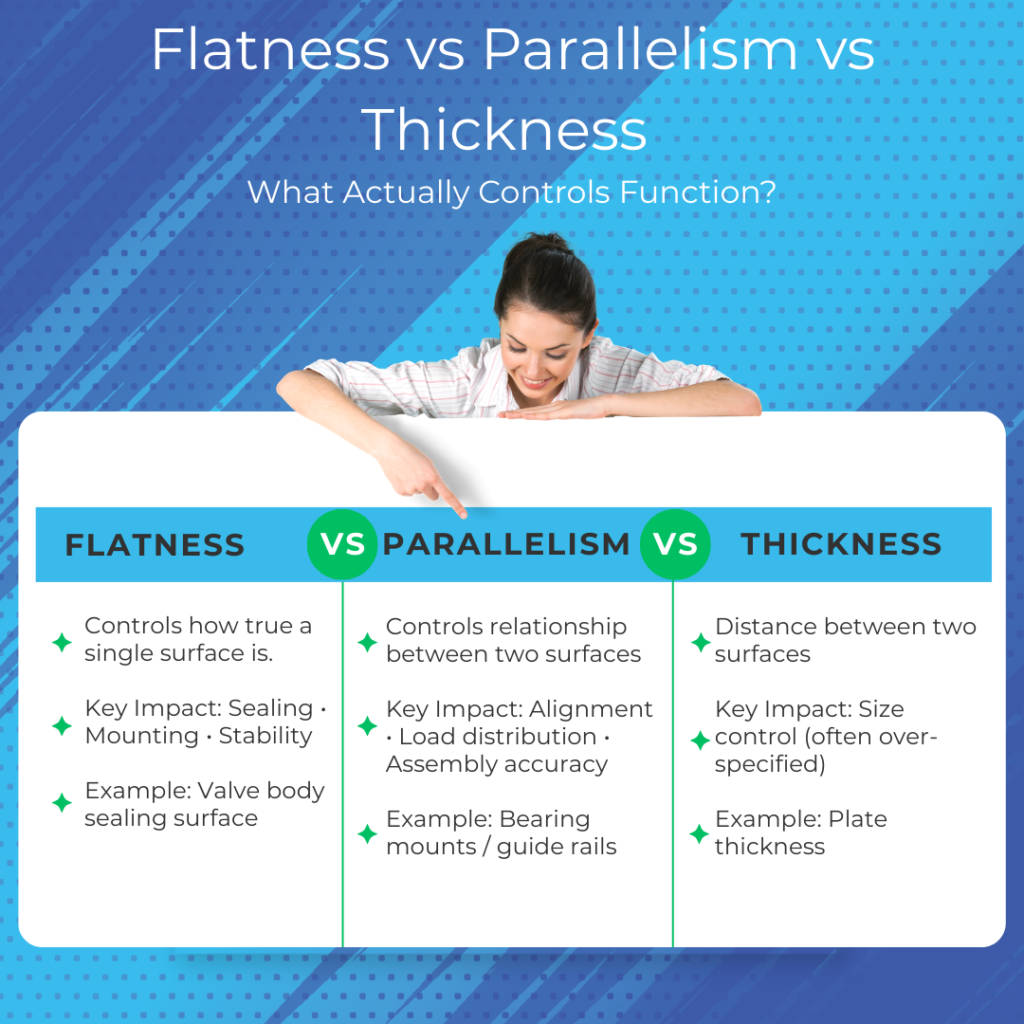
Flatness
0.0005″–0.002″ depending on size
Parallelism
0.0005″–0.002″
Thickness control
±0.001″ typical

These depend heavily on:

Material stability (aluminum vs steel vs castings)

Part size and aspect ratio

Workholding method

Toolpath strategy

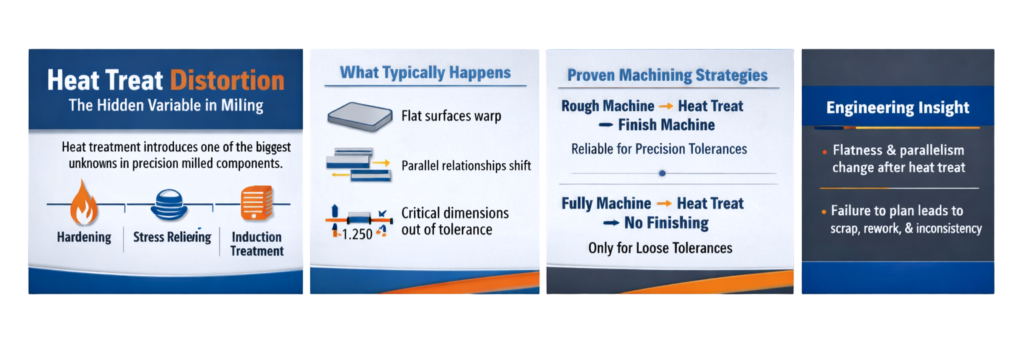
Heat treat condition

For large plates or thin components, flatness becomes significantly harder to control.

Flatness vs Parallelism vs Thickness

Datums & Functional Stack-Up — Where Accuracy Actually Lives

For high-precision CNC milling, machined datums are the foundation of part function — not just dimensional accuracy.

Datums determine:

  • How a part locates in assembly

  • How tolerances stack across components

  • Which surfaces truly control performance

Where things go wrong

A common issue in CNC milling tolerances is applying tight requirements across non-critical surfaces.
This leads to:
– Increased machining time
– Over-processing
– Unnecessary grinding or rework

A more effective approach

A functional datum strategy focuses on hierarchy:

Primary datum (A): Base surface — controls stability and mounting
Secondary datum (B): Alignment — controls orientation
Tertiary datum (C): Locks position or rotation

This structure ensures that precision milled components are controlled where it matters most — not everywhere.

If datum structure is wrong, the entire tolerance stack collapses — regardless of how tight individual dimensions are held.

Workholding Strategy = Geometry Control

In milling, how the part is held directly affects accuracy.

Common Workholding Methods

Vise Clamping

- Fast and repeatable
- Good for smaller, rigid parts
- Can introduce distortion if over-clamped

Vacuum Workholding

- Ideal for thin plates
- Minimizes distortion from clamping forces
- Limited holding force

Fixture Plates / Custom Fixtures

- Best for production consistency
- Maintains datum relationships

Soft Jaws / Contoured Workholding

- Used for complex geometry
- Improves repeatability across batches

Heat Treat Distortion in Milled Parts

Heat Treat Distortion in Milled Parts

When Milling Is Not Enough (And Grinding Takes Over)

Milling is efficient — but not limitless.

When Milling Is Not Enough (And Grinding Takes Over)

Milling Alone Is Sufficient When:
– Flatness ≥ 0.001″
– Surface finish ≥ 32–63 µin Ra
– Tolerance ≥ ±0.001″
– No extreme contact or sealing requirement

Grinding Becomes Necessary When:
– Flatness ≤ 0.0005″
– Surface finish ≤ 16 µin Ra
– Critical sealing or wear surfaces
– Tight parallelism across large areas

Grinding Becomes Necessary When

Surface Finish Limits of CNC Milling

Typical Milling Finish:

Operation Surface Finish
Rough milling
125–250 µin Ra
Standard finish
63–125 µin Ra
Fine finish
32–63 µin Ra
High-end finish pass
16–32 µin Ra

Work with a Shop That Understands Functional Geometry

At Baxter Machine & Tool, we approach milling differently. We don’t just machine features — we evaluate:

– Which surfaces are true datums
– Where flatness actually impacts function
– How tolerances stack across your assembly
– Whether milling alone is sufficient — or grinding is required

Stay Updated With Machining Insights

Weekly updates on machining, grinding, tolerancing, and process optimization.