CNC Tolerances Explained: How Tight Is Too Tight? A Practical Guide for Engineers

CNC Tolerances Explained How Tight Is Too Tight? A Practical Guide for Engineers​

Executive Summary

Tighter tolerances are not always better. They increase cost, reduce yield, and limit supplier options—often without improving function.

Key points engineers should remember:

  • Tolerance should follow function, not habit or legacy prints
  • Every extra tenth adds cost exponentially, not linearly
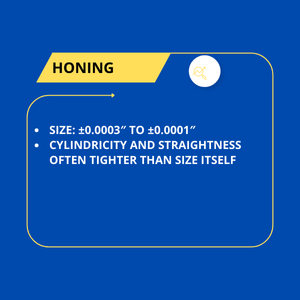
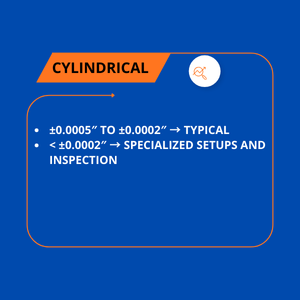
  • Different processes (turning, milling, grinding, honing) have very different tolerance capabilities
  • GD&T is powerful—but only when used intentionally
  • Surface finish, material, datum structure, and process order all influence achievable tolerance

Baxter perspective: Process-first quoting aligns tolerances with the right machining and finishing route so precision is achieved without unnecessary cost or risk.
What “Tolerance” Really Means in
CNC Machining

In machining, tolerance defines the allowable variation in a feature’s size, form, or position while still meeting functional requirements. It is not a measure of quality by itself—it is a design decision that directly affects manufacturability, cost, and yield.

A ±0.001″ tolerance does not simply mean “machine carefully.” It implies:

  • More stable fixturing
  • More controlled cutting forces
  • Tighter thermal control
  • More inspection time
  • Higher scrap risk

The most common mistake engineers make is assuming tighter tolerance automatically means better performance. In reality, performance depends on fit, alignment, load, motion, and sealing—not raw numerical tightness.

Tolerance is a communication tool.
When used correctly, it tells manufacturing where precision matters. When overused, it hides design intent and drives cost.

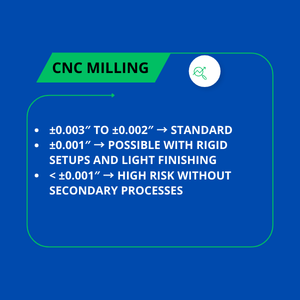
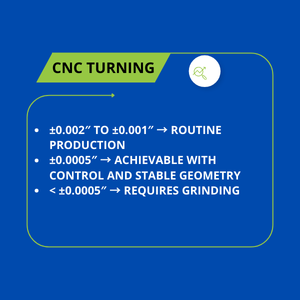
Standard CNC Tolerance Ranges
(What’s Realistic)

Not all machining processes are created equal. Expecting the same tolerance from milling, turning, grinding, and honing leads to frustration on both sides of the RFQ. 
Below are realistic, production-ready tolerance bands when processes are properly planned.

Typical Tolerance Capability by Process

How Tight Is Too Tight? The Cost Curve Engineers Rarely See

Tolerance cost does not scale evenly. It follows an exponential curve.

Reducing a tolerance from:

±0.005″ → ±0.002″ may increase cost modestly
±0.002″ → ±0.001″ increases cost noticeably
±0.001″ → ±0.0005″ can double or triple cost

Why? Because tighter tolerances require:

- More rigid fixtures
- Slower feeds and speeds
- Additional finishing passes
- Higher scrap risk
- More inspection and documentation

Common red flags on prints:

- Blanket ±0.001″ across the entire part
- Tight tolerances on cosmetic or non-functional surfaces
- Tolerances tighter than the mating part requires

Rule of thumb:

If you cannot explain why a tolerance is tight, it probably shouldn’t be.

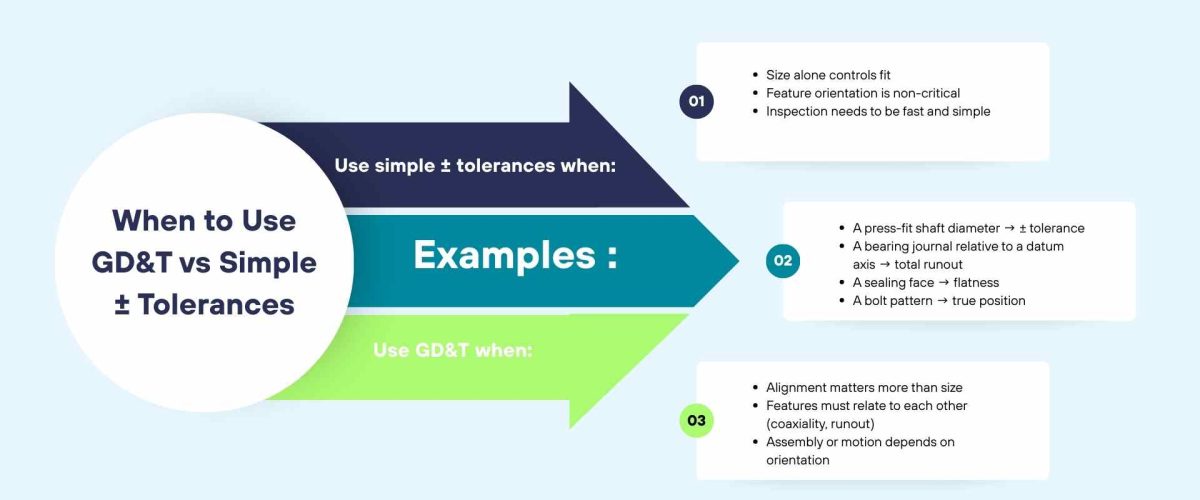
When to Use GD&T vs Simple ± Tolerances

GD&T is not “advanced tolerancing.” It is functional tolerancing.

process
Best practice
One primary datum
One secondary datum
GD&T applied only where function demands

Surface Finish, Material & Datum
Choice — The Hidden Tolerance Drivers

Tolerance does not exist in isolation. It is deeply connected to surface finish, material behavior, and datum structure.

 
Surface Finish
 

A feature specified at Ra 8 µin will behave differently than the same feature at Ra 63 µin:

 
  • Finer finishes often require lighter cuts
  • Lighter cuts reduce tool pressure—but increase cycle time
  • Finish requirements may force grinding or honing
 
Material
 

Materials respond differently under the same tolerance:

 
  • Aluminum machines predictably
  • Low-carbon steels move modestly
  • Alloy steels (4140, 4340) may distort after heat treat
  • Stainless steels add thermal instability
 
Datums
 

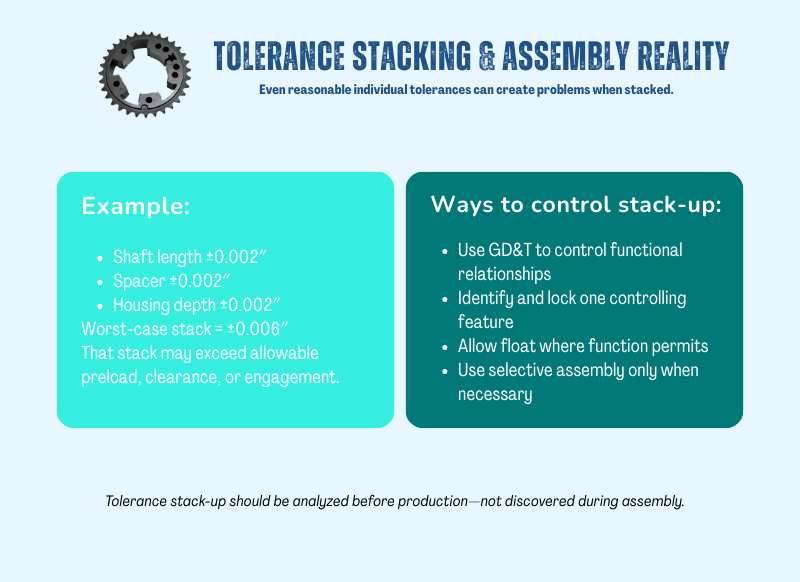
Poor datum choices amplify tolerance stack-up.

 
  • Datums should reflect how the part is fixtured and assembled
  • Changing datums between operations increases variation
  • Datum alignment must match process flow
 

🧠 Key insight:


You don’t “hold tolerance” — you design a process that naturally produces it.

How Baxter Machine & Tool Approaches Tolerances

  • Identify functional vs non-functional features

  • Align tolerances to the correct process (turn, mill, grind, hone)

  • Recommend where tolerances can be relaxed safely

  • Flag tolerances that drive cost without adding value

Stay Updated With Machining Insights

Weekly updates on machining, grinding, tolerancing, and process optimization.