CNC Turning for Precision Shafts & Rotational Components

(Tolerances, Surface Finish & Geometry Control)

When engineers search for CNC turning tolerances or precision shaft machining, they’re usually trying to answer one critical question:

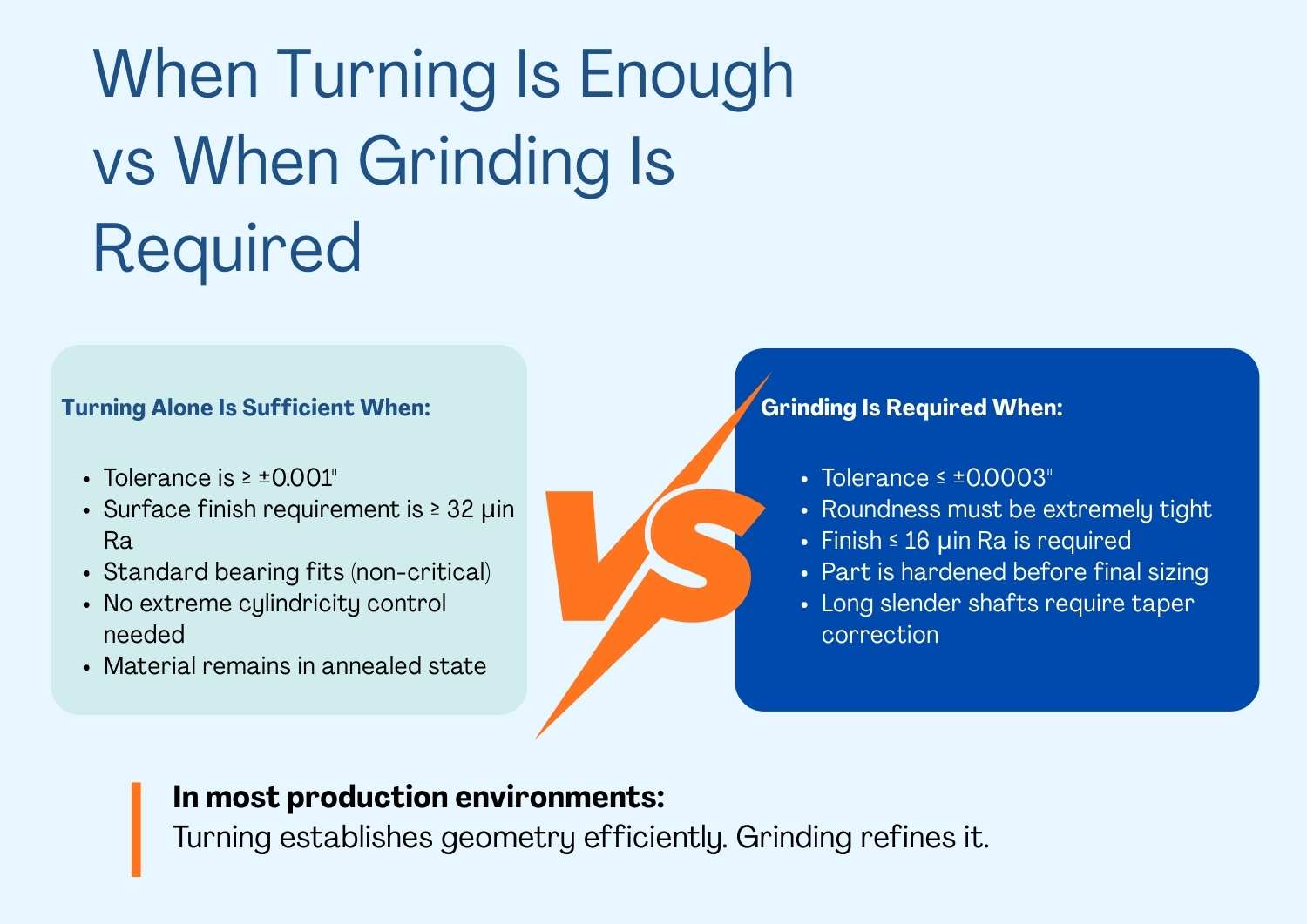
Can this part be held in turning — or does it require grinding?

For rotational components like shafts, journals, spacers, and spindles, the answer determines cost, lead time, and long-term performance. Below is a practical, engineer-first breakdown of what CNC turning can realistically achieve in production.

Realistic CNC Turning Tolerance Bands

Modern CNC lathes are highly capable, but tolerance expectations must align with real production conditions — not lab numbers.
Typical Production Capability for Turned Parts
Feature Realistic Capability
General OD diameters
±0.001″ to ±0.002″
Precision shaft journals
±0.0005″ to ±0.001″
Length tolerances
±0.001″ to ±0.003″
Runout (TIR)
0.0005″–0.002″
Taper (short parts)
≤0.0005″/inch achievable

Capability depends on:

Material stability
Tool wear management
Machine condition
Fixturing method
Heat treat considerations

Note – If a drawing calls for ±0.0002″ across a shaft length, turning alone is rarely the final process.

Benefits and Risks Financial Education Graphic Organizer in Dark Green Light Blue Teal Illustrative Style

Controlling Taper, Runout & Concentricity

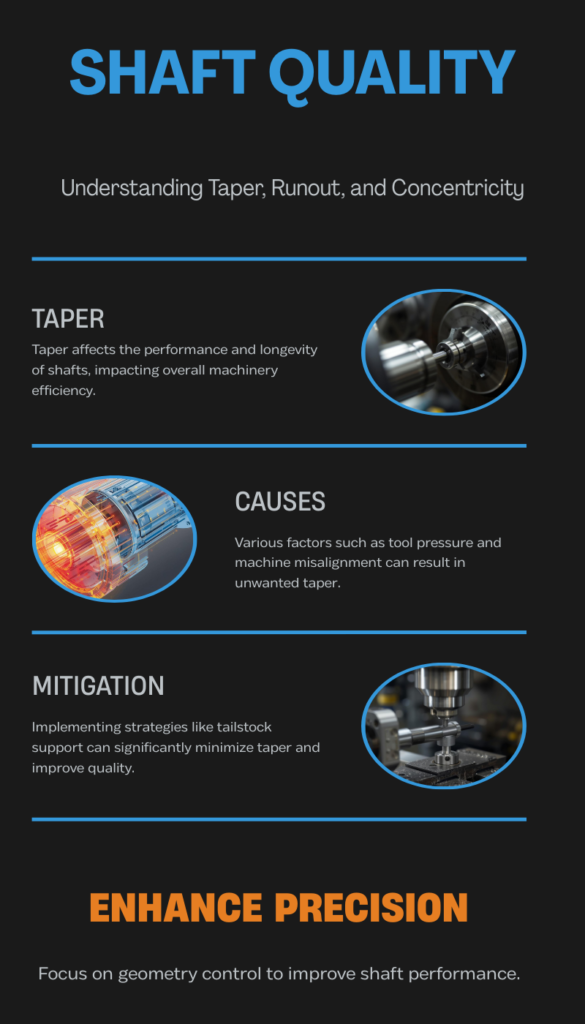
Diameter alone does not define shaft quality. Geometry control matters.
Taper Control

Taper can result from:

  • Tool pressure
  • Thermal growth
  • Shaft deflection
  • Machine misalignment

Mitigation strategies include:

  • Tailstock or steady rest support
  • Reduced depth of cut on finish pass
  • Balanced roughing strategy
  • In-process compensation

Note: Short shafts (low length-to-diameter ratio) are easier to control.

Runout (TIR)

Runout is often the most functional geometric control for rotating components.
Common Causes
  • Chuck jaw distortion
  • Bar stock inconsistency
  • Setup stack variation
Concentricity vs Runout
Engineers frequently overspecify concentricity when runout would control function.
  • Runout measures how a surface rotates relative to an axis.
  • Concentricity (GD&T) is mathematically stricter and harder to measure.
If function depends on rotation, sealing, or bearing alignment, runout is usually the more practical specification.
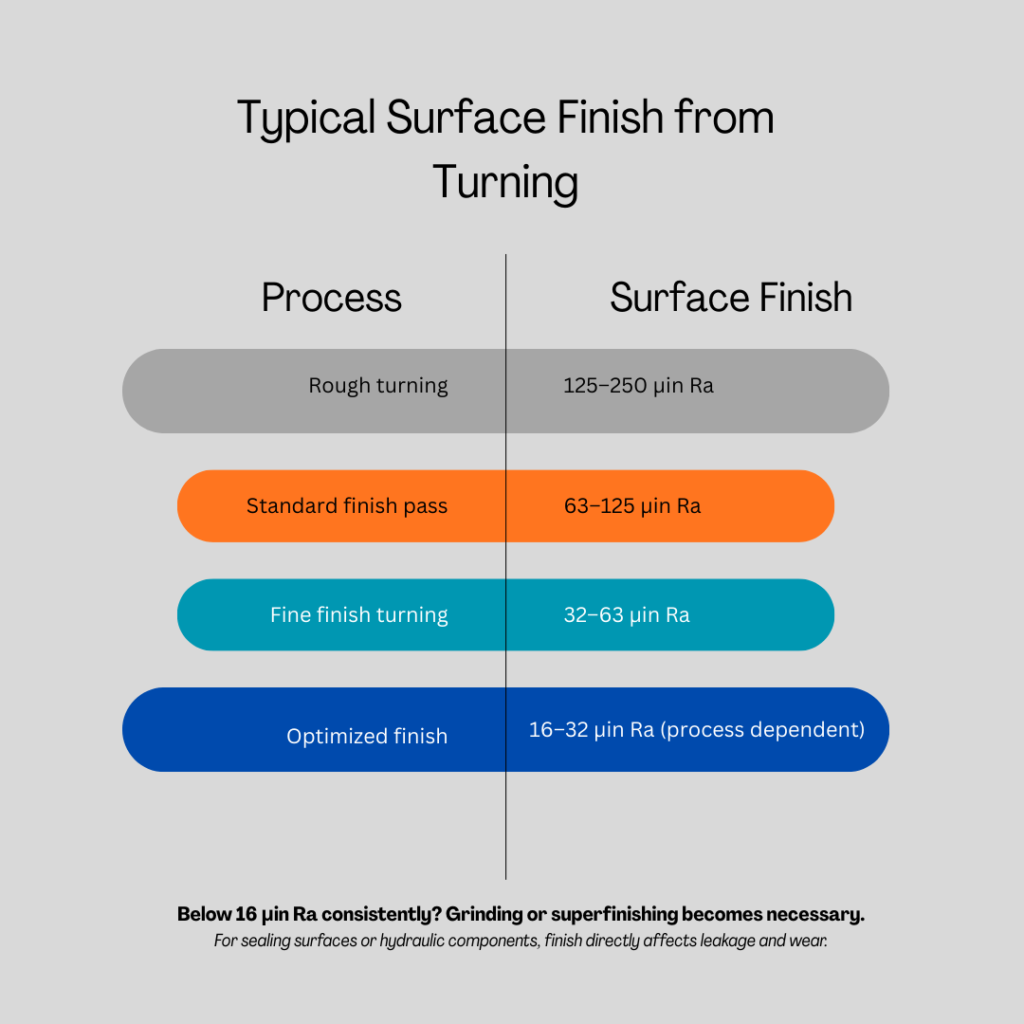
Surface Finish Limits of CNC Turning
  • Insert geometry
  • Feed rate
  • Nose radius
  • Material hardness
  • Machine rigidity
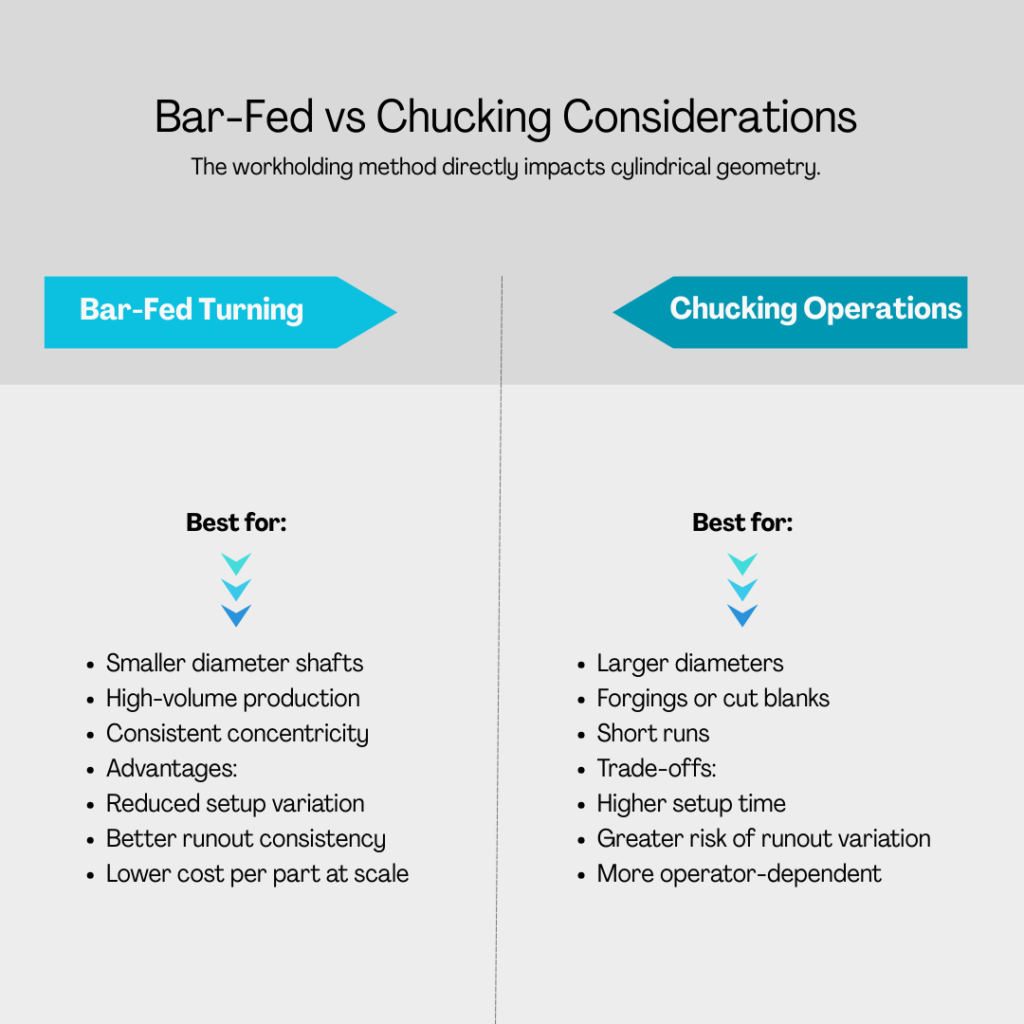
Bar-Fed vs Chucking Considerations

Turning + Post-Heat-Treat Strategy

Heat treatment introduces distortion — and must be planned into the tolerance stack.

Two common approaches:

Strategy 1: Turn → Heat Treat → Finish Grind

Most reliable for tight-tolerance hardened shafts.

Strategy 2: Turn to Compensated Size → Heat Treat → No Grinding

Only viable when tolerance bands are forgiving.

Ignoring heat treat distortion is one of the most common causes of scrap in precision shaft machining.

At Baxter Machine & Tool, we don’t just run your print — we evaluate it.

✔ Fewer unnecessary operations
✔ More stable production
✔ Lower total cost
✔ Tolerances that perform in the real world

Stay Updated With Machining Insights

Weekly updates on machining, grinding, tolerancing, and process optimization.