In-House Grinding vs. Outsourcing: Cost, Quality, and Risk
Comparison of in-house grinding versus outsourced grinding showing differences in cost, quality, and risk for precision machined parts.

Executive Summary

Grinding is not just a finishing step—it is a geometry-control operation.
The decision to keep grinding in-house or outsource it affects tolerance capability, scrap risk, lead time, and total cost far more than most engineers expect.

Key takeaways:

  • Grinding becomes mandatory when turning or milling can’t hold geometry reliably
  • Outsourcing grinding adds hand-offs, datum changes, and schedule risk
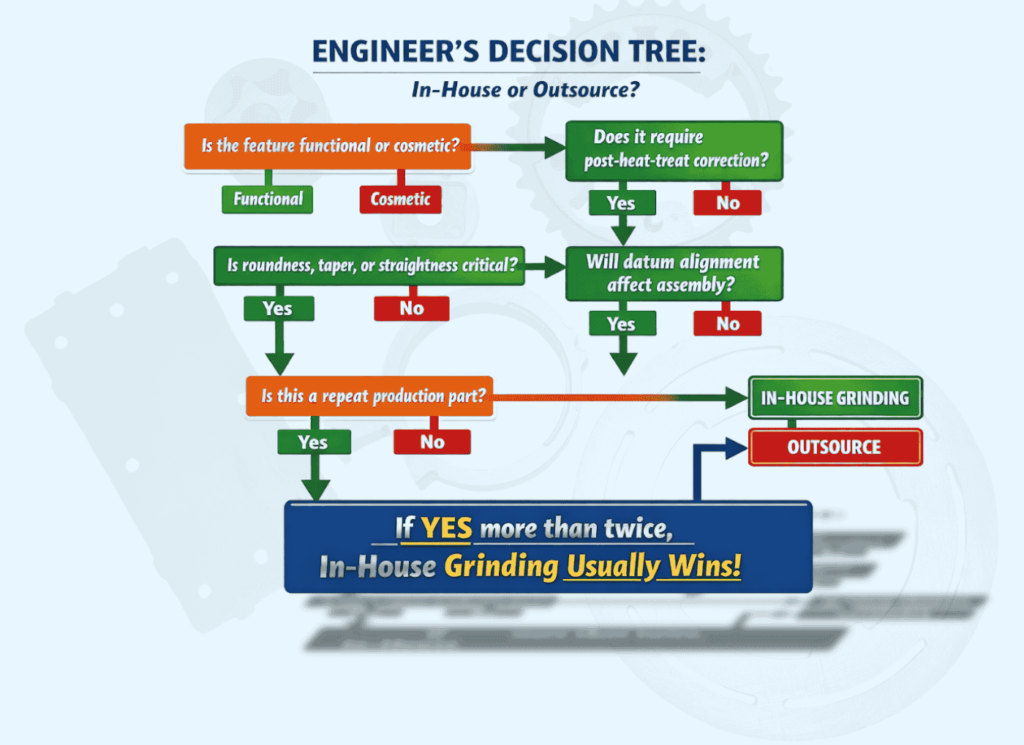
  • In-house grinding improves roundness, taper control, and repeatability
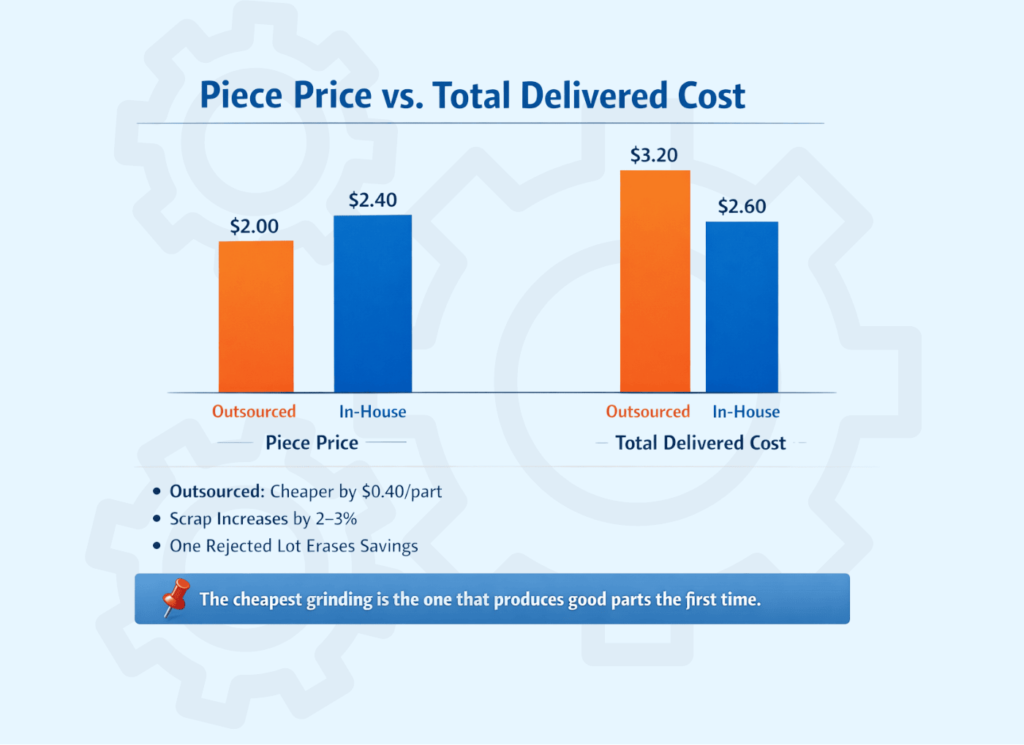
  • Cost comparisons must include scrap, freight, and rework—not just piece price

Baxter perspective: When turning, grinding, and honing are integrated under one roof, geometry stays controlled and variation stays contained.
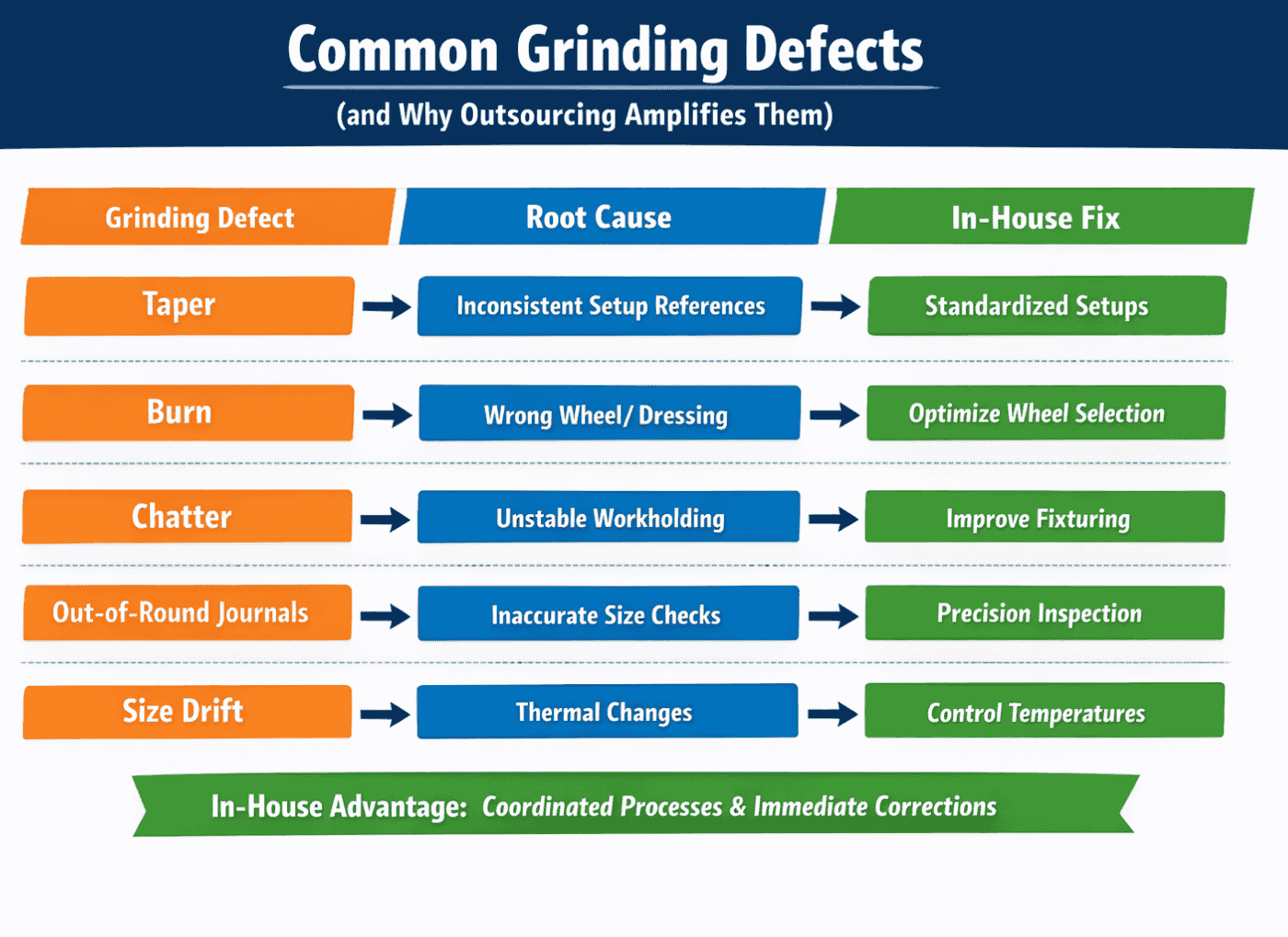
“`
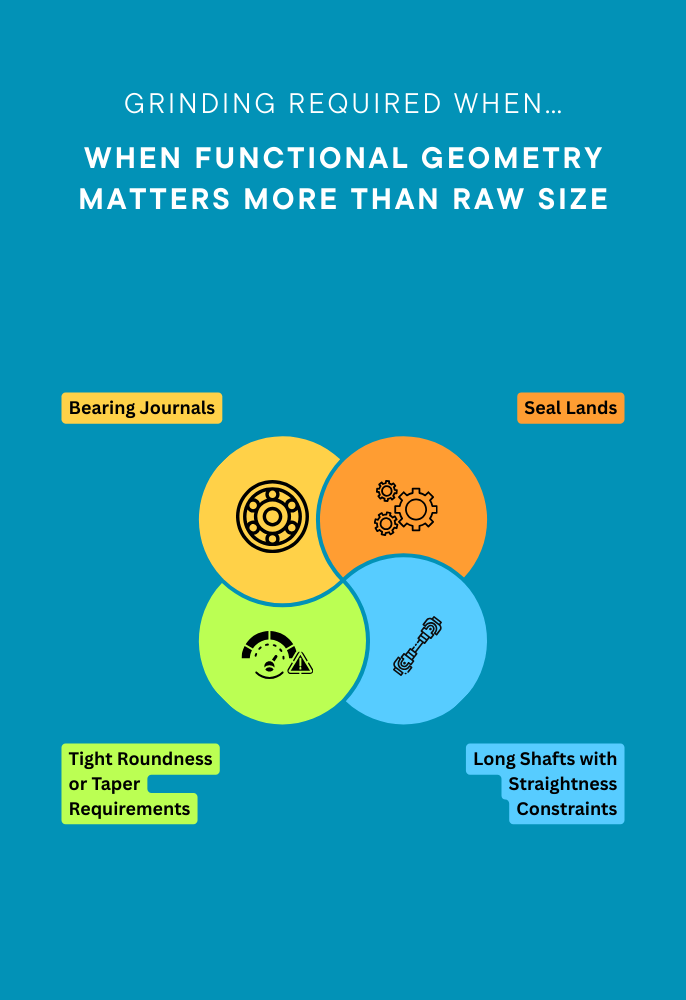
Grinding is mandatory for bearing journals, seal lands, long shafts, and tight roundness or taper requirements

When Grinding Is Mandatory (Not Optional)

Grinding is required when functional geometry matters more than raw size.
Grinding is typically mandatory for:
Bearing journals
Post-heat-treat features
Long shafts with straightness constraints
Seal lands
Tight roundness or taper requirements

Datum Stack-Up: The Hidden Cost of Outsourcing

Every time a part leaves the building:

  • New fixturing is used
  • Datums are interpreted differently
  • Small alignment errors accumulate

By the time the part returns from outsourced grinding, it may be:

  • On size
  • But misaligned to the original datum
  • Or out of round relative to mating features
Why in-house finishing matters?
Datums remain consistent
Setup intent is preserved
Functional relationships stay intact

OD Grinding vs Surface Grinding (Quick Decision Guide)

Selecting the correct grinding process determines whether geometry can be held reliably and cost-effectively. OD grinding and surface grinding solve different problems and are not interchangeable.

OD (Cylindrical) Grinding

Used for rotational components where concentricity matters.

  • Shafts, journals, bearing surfaces
  • Controls roundness, taper, and size
  • Ideal for post-heat-treat geometry

Surface Grinding

Used for planar features where flatness is critical.

  • Flats, faces, parallel features
  • Controls flatness and thickness
  • Often paired with milling

Engineering rule: If the part rotates, OD grinding is usually required. If the part locates or stacks, surface grinding is typically the correct choice. Choosing the wrong method increases cost and reduces capability.

Results From Real Production Programs

Feedback from customers running tight-tolerance parts through integrated machining and in-house grinding.

Baxter is a very easy company to do business with. The hard gauges that Baxter has developed internally, provide a high level of assurance that the parts are being machined to customer specifications every time.

Rated 4.2 out of 5
Saul Skippers

Sales Manager

Baxter Machine has provided us exceptional machining and grinding services for some very challenging automotive transmission components.

Rated 4 out of 5
Karl Christianson

Process Engineer

Through our commercial relationship, Tremec has received outstanding service and quality from Baxter Machine. Baxter has always been willing to provide engineering and development support to our company.

Rated 3.7 out of 5
Eduardo Valencia

Corporate Purchasing Manager

Working with Baxter Machine has been an outstanding experience! Their attention to detail, quality craftsmanship, and commitment to delivering top-notch industrial machinery exceeded our expectations.

Rated 4.1 out of 5
John Doe

Operations Manager

How Baxter Machine & Tool Executes Grinding Correctly

    • Recover geometry after heat treat

    • Maintain datum integrity

    • Reduce scrap and rework

    • Shorten lead times

    • Support both prototype and production volumes

Stay Updated With Machining Insights

Weekly updates on machining, grinding, tolerancing, and process optimization.